
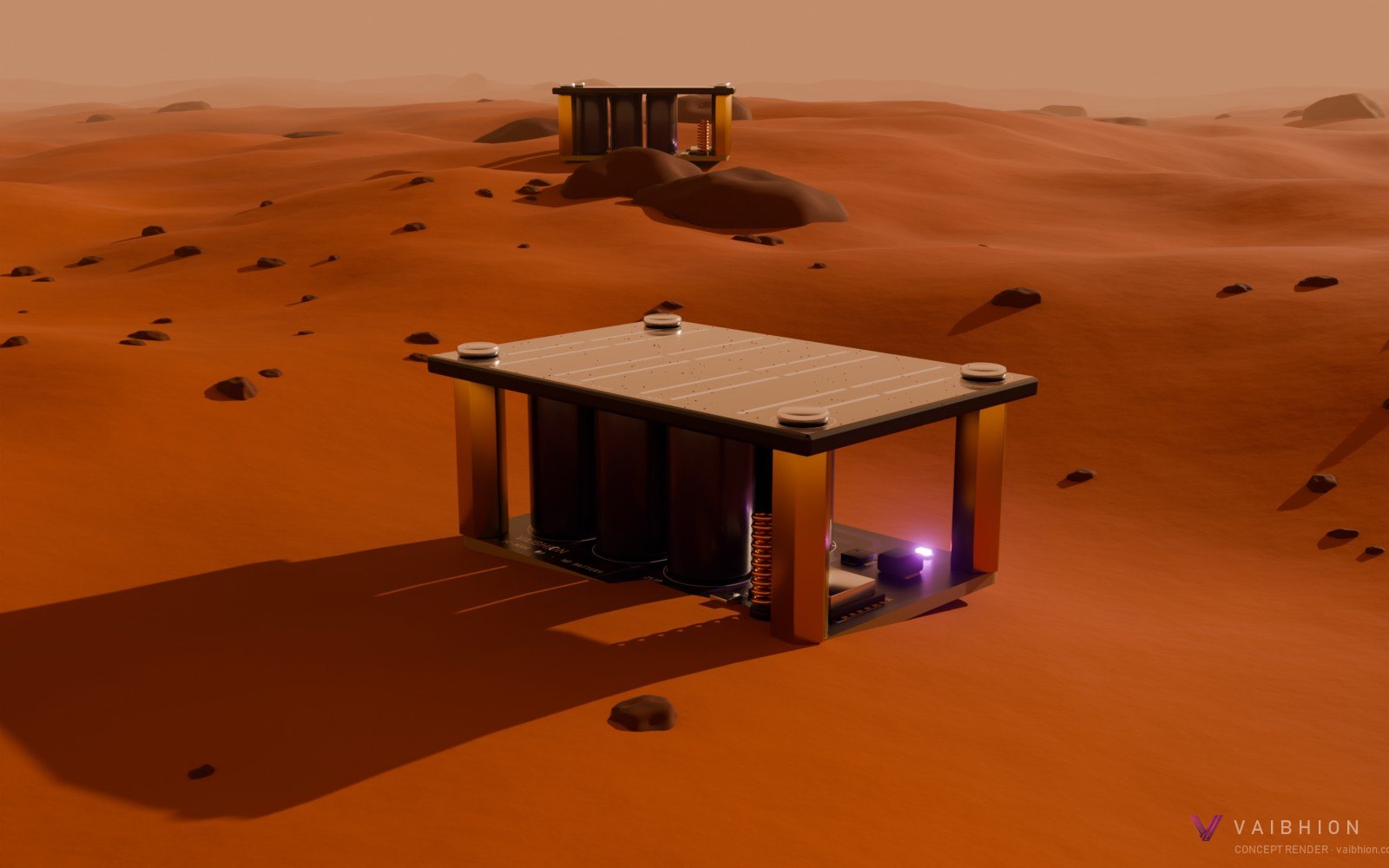
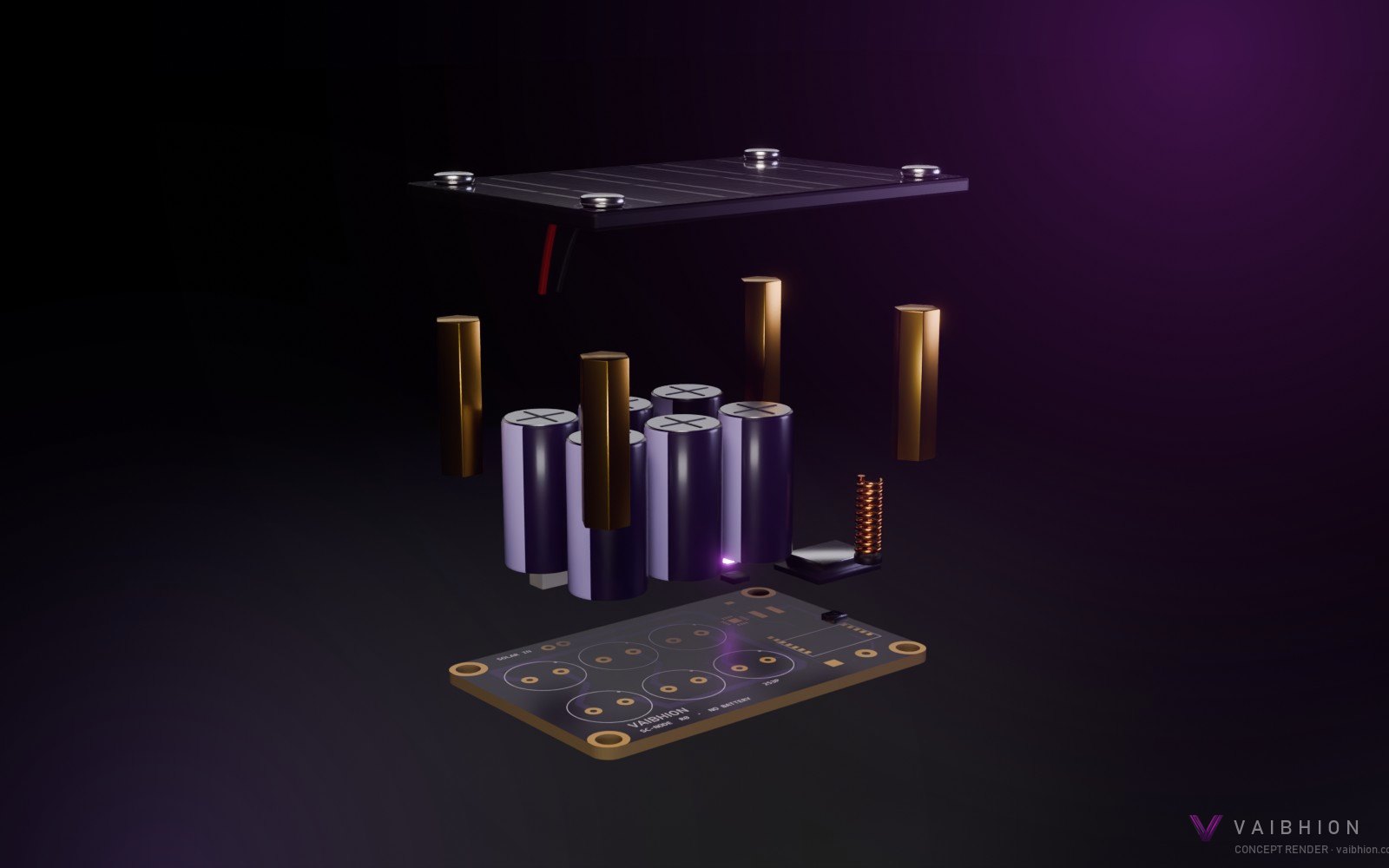
Concept of the test node, not final hardware. Drag to turn it, pull it apart, or look underneath.
Power that outlasts the dark
We are building a power system with no battery at all. Small solar panels charge banks of supercapacitors, and those banks keep a low-power sensor alive through nights, cloudy weeks and, one day, Martian dust storms.
Why no battery?
In a remote sensor that recharges every day, the battery is often the first thing to wear out. A rechargeable cell lasts a few hundred to a few thousand cycles, loses capacity in the cold, and has to be replaced, which is hard on a hilltop, along a pipeline, and impossible on another planet.
Supercapacitors store charge in a different way. They take hundreds of thousands to a million charge cycles, charge in minutes instead of hours, and keep working down to about −40 °C.
The idea
Small solar panels feed banks of supercapacitors wired in series for voltage and in parallel for capacity. A harvester circuit moves as much of that energy as it can into the bank. The electronics sleep almost all the time, wake for a moment to measure and send, and go back to sleep.
What we are aiming for:
- A few minutes of good sun refill the bank
- The bank then carries the node through nights and long dark spells
- When good light comes back, it fills up again quickly
The hard part: every microwatt counts
A supercapacitor stores far less energy than a battery of the same size, and it slowly leaks its own charge. So the whole design is an energy budget. As an example, a bank with about 1 kJ of usable energy that has to last 4 months can spend only about 96 µW on average. For 6 months it is about 64 µW. That budget has to cover the electronics and the bank's own leakage.
- For many off-the-shelf supercapacitors, the bank's own leakage can use up most or all of this budget, so finding and measuring low-leakage banks is the first test
- How many months the node lasts depends directly on how much extra power the electronics draw
- Leakage changes with temperature and with how the bank was charged, so it must be measured over weeks, not minutes
- Series banks need balancing, and balancing must not waste the energy it protects
Why Mars
On Mars a solar machine lives or dies by its power store. NASA's Opportunity rover went silent on 10 June 2018, when a planet-wide dust storm blotted out the Sun. The InSight lander last called home on 15 December 2022, after dust slowly covered its solar panels.
Mars gets only about 43% of the sunlight Earth gets, and dust storms can dim it for weeks. A store that does not wear out with cycles, takes charge as fast as the panel can give it, and can sit through a storm could suit small Mars sensors well. Mars is also colder than ordinary supercapacitors are rated for, so keeping the bank warm, with insulation and with spare solar energy by day, is part of this research too.
What we are testing now
- Charge time from small panels, in full sun and in weak light
- How long the bank carries a real sensor load in the dark
- Self-discharge of the bank over weeks, at different temperatures
- Sleep current of the electronics, down to microamps and below
- Series and parallel layouts, and balancing that wastes almost nothing
Status
Research and testing in Dehradun. The numbers on this page are our targets, not results yet. We will add measured numbers here as the tests run.
Renders
Concept renders and an illustration, not final hardware. Targets are goals, not measured results.